
Most lumps, bumps and growths that appear on the skin are benign, but getting the diagnosis right is still important before trying to treat them. Some harmless lesions can resemble other skin conditions, and the best treatment approach may vary depending on the type of growth, its location and your skin tone.
In this article, consultant dermatologist Dr Derrick Phillips explains five of the most common benign skin growths he sees in clinic, why they develop, and how they can be treated.
1. Intradermal Moles
Intradermal moles are a common, benign type of mole. They are typically soft and raised, ranging from skin-coloured or pink to brown, and can appear on the face, scalp or elsewhere on the body. Removal is usually a cosmetic choice, although some people choose to have them removed if they repeatedly catch on clothing, jewellery or during shaving.
Dr Phillips’ preferred approach for suitable raised intradermal moles is with a shave excision biopsy. After injecting local anaesthetic, the raised portion of the mole is carefully shaved flush with the surrounding skin. The area is then cauterised to stop any bleeding, and the removed tissue is sent to the laboratory for histological examination to confirm the diagnosis.
The procedure is quick, usually heals well and can produce a good cosmetic result without the linear scar associated with surgical excision. However, because shave removal does not necessarily remove the entire mole beneath the skin surface, there is a possibility that some of the mole may regrow over time.
The practical takeaway: intradermal moles are harmless and do not usually need treatment. If you would like one removed, it is important to have it assessed first to confirm the diagnosis and discuss the treatment most likely to give the best cosmetic result.
2. Spider Angiomas
Spider angiomas are small, benign clusters of superficial blood vessels with a central red point and fine vessels radiating outwards, giving them a spider-like appearance. They are most commonly seen on the face, neck and upper chest. They are very common and may develop with age, during pregnancy or in association with hormonal changes.
Dr Phillips treats suitable spider angiomas with the Lutronic Derma V, a vascular laser that selectively targets the blood vessels supplying the lesion. The treated vessels are heated and gradually fade over the following days to weeks.
Treatment is usually quick and associated with minimal downtime, although temporary redness or swelling can occur afterwards.
Most spider angiomas are completely harmless. However, if multiple lesions appear suddenly or in large numbers, particularly without an obvious trigger, it is worth having them assessed because, more rarely, numerous spider angiomas can be associated with underlying medical conditions including liver disease.
The practical takeaway: isolated spider angiomas are usually a cosmetic concern and can respond very well to vascular laser treatment.
3. Verrucas
Verrucas are caused by infection with certain types of human papillomavirus (HPV), which infect the outer layers of the skin. They most commonly occur on the soles of the feet, while similar viral warts can appear on the hands and elsewhere on the body.
Dr Phillips’ usual approach combines a salicylic acid wart treatment used regularly at home with periodic liquid nitrogen cryotherapy in clinic. Salicylic acid gradually removes infected surface skin, while cryotherapy freezes and damages wart tissue. Using both can be a useful approach for persistent lesions.
The main thing patients underestimate is how long treatment can take. Verrucas often need several weeks to months of consistent treatment before they clear, and progress can be gradual. Stopping too early is one of the most common reasons treatment fails.
The practical takeaway: consistency matters. Verrucas can be stubborn, and even effective treatment often requires repeated applications and several clinic sessions before the wart fully resolves.
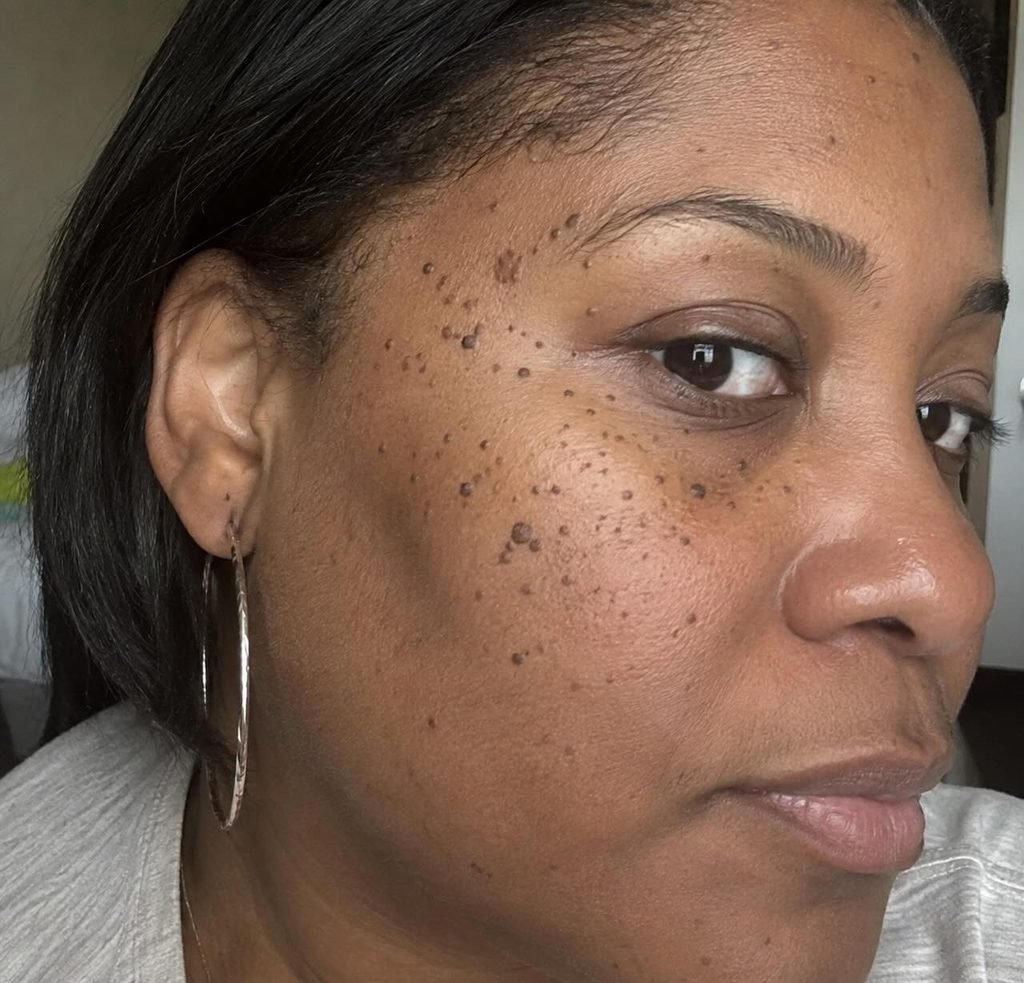
4. Dermatosis Papulosa Nigra (DPN)
Dermatosis papulosa nigra (DPN) are multiple small, smooth, dark brown or black bumps, most commonly on the face and neck. It is particularly common in people with darker skin tones, tends to run in families and often begins in adolescence or early adulthood, gradually increasing in number with age.
Dr Phillips’ preferred treatment is low-energy cautery followed by gentle curettage. This allows the lesions to be removed precisely while minimising unnecessary damage to the surrounding skin.
Technique is especially important when treating DPN because darker skin is more prone to post-inflammatory hyperpigmentation or, less commonly, hypopigmentation after treatment. Cryotherapy can therefore carry a higher risk of unwanted pigmentary change and is generally used cautiously, if at all.
Sun protection after treatment is also important to reduce the risk of post-inflammatory pigmentation and help the skin heal as evenly as possible.
The practical takeaway: DPN is completely benign and does not need treatment unless you would like the lesions removed for cosmetic reasons. If you do, choose a clinician experienced in treating darker skin tones, as the technique used can significantly influence the cosmetic outcome.
5. Sebaceous Hyperplasia
Sebaceous hyperplasia causes small, yellow or flesh-coloured, dome-shaped bumps, often with a subtle central dimple. They most commonly appear on the face from midlife onwards and develop when the sebaceous, or oil-producing, glands become enlarged.
They are sometimes mistaken for milia or clogged pores, but they are caused by an enlarged oil gland rather than trapped keratin or a blocked pore, so they require a different treatment approach.
See How to Get Rid of Milia for more information on this common lookalike.
Dr Phillips’ preferred treatment is low-energy cautery, which allows the enlarged gland to be treated precisely while minimising damage to the surrounding skin. The treated area forms a small crust before healing over the following days.
The practical takeaway: sebaceous hyperplasia is completely benign and does not need treatment unless it is cosmetically bothersome. It is worth having the diagnosis confirmed before treatment, as some other skin lesions can occasionally have a similar appearance.
Honorary Mention: Seborrheic keratosis
One benign growth that did not make Dr Phillips’ original list, but is extremely common, is seborrhoeic keratosis. These usually appear as well-defined, slightly rough or waxy growths with a characteristic “stuck-on” appearance. They become more common with age and can occur almost anywhere on the body.
Seborrhoeic keratoses can sometimes be confused with other pigmented lesions, so it is worth having them assessed if the diagnosis is uncertain. Very rarely, the sudden appearance of multiple new seborrhoeic keratoses has been described in association with internal disease, although this is uncommon.
Frequently Asked Questions in Clinic
How can I tell if a skin growth is dangerous?
There is no single rule that reliably distinguishes a harmless growth from skin cancer. For pigmented lesions, the ABCDE warning signs for melanoma, asymmetry, irregular borders, uneven colour, increasing diameter and evolution or change, can be useful. More generally, any growth that is new, changing, repeatedly bleeding or crusting, persistently painful or looks noticeably different from your other lesions should be assessed.
Do harmless skin growths need to be removed?
No. Once a growth has been confirmed as benign, removal is usually a personal or cosmetic choice. Treatment may also be considered if a lesion repeatedly catches on clothing, becomes irritated or causes other symptoms.
What’s the difference between DPN and seborrhoeic keratosis?
Both can appear as small brown or dark growths. Dermatosis papulosa nigra (DPN) tends to produce multiple small, smooth bumps on the face and neck, often beginning earlier in life, and is particularly common in people with darker skin tones. Seborrhoeic keratoses tend to develop later in life and often have a rougher, waxy or characteristic “stuck-on” appearance.
Can verrucas spread?
Yes. Verrucas are caused by human papillomavirus (HPV) and can spread to other areas of your own skin or between people. The virus can also be acquired from contaminated surfaces, particularly in warm, moist environments such as communal changing rooms and swimming pools.
Are yellow bumps on the face always sebaceous hyperplasia?
No. Sebaceous hyperplasia is one possible cause, but other conditions, including milia, can have a similar appearance. Some skin cancers can also occasionally resemble sebaceous hyperplasia, which is another reason to have an uncertain lesion properly assessed before treating it.
When should I get a skin growth checked by a dermatologist?
Have a growth assessed if it is new or changing, particularly if it changes in size, shape or colour, repeatedly bleeds or crusts without an obvious reason, becomes persistently painful or itchy, or looks noticeably different from your other moles or marks. You should also have a lesion checked before attempting to remove it if you are unsure of the diagnosis.
Can a harmless skin growth become cancerous?
Most benign skin growths do not turn into skin cancer. The more important consideration is that benign lesions and skin cancers can sometimes look similar. Getting an accurate diagnosis is therefore more important than trying to identify a growth yourself from photographs or descriptions online.
Can benign skin growths come back after removal?
Sometimes. This depends on the type of growth and how it was treated. An intradermal mole, for example, can occasionally regrow after shave removal because some naevus cells may remain deeper in the skin. With other conditions, the treated lesion may not return but new lesions can develop elsewhere over time.
Will removing a benign skin growth leave a scar?
Any procedure that removes or destroys skin tissue has the potential to leave a scar or pigmentary change. The risk depends on the type and depth of the growth, its location, the treatment used and how your skin heals. Dr Phillips considers the likely cosmetic outcome when recommending treatment, particularly for visible areas such as the face.
Why does skin tone matter when removing benign skin growths?
Darker skin tones can be more prone to post-inflammatory hyperpigmentation and hypopigmentation following procedures that heat, freeze or otherwise injure the skin. This does not mean benign growths cannot be treated safely, but the technique and treatment settings need to be selected carefully. This is particularly important when treating dermatosis papulosa nigra, where minimising unwanted pigmentary change is an important part of treatment planning.
Author: Dr Derrick Phillips, Consultant Dermatologist, MBBS BSc (HONS) FRCP (Dermatology)
Last reviewed: September 2026