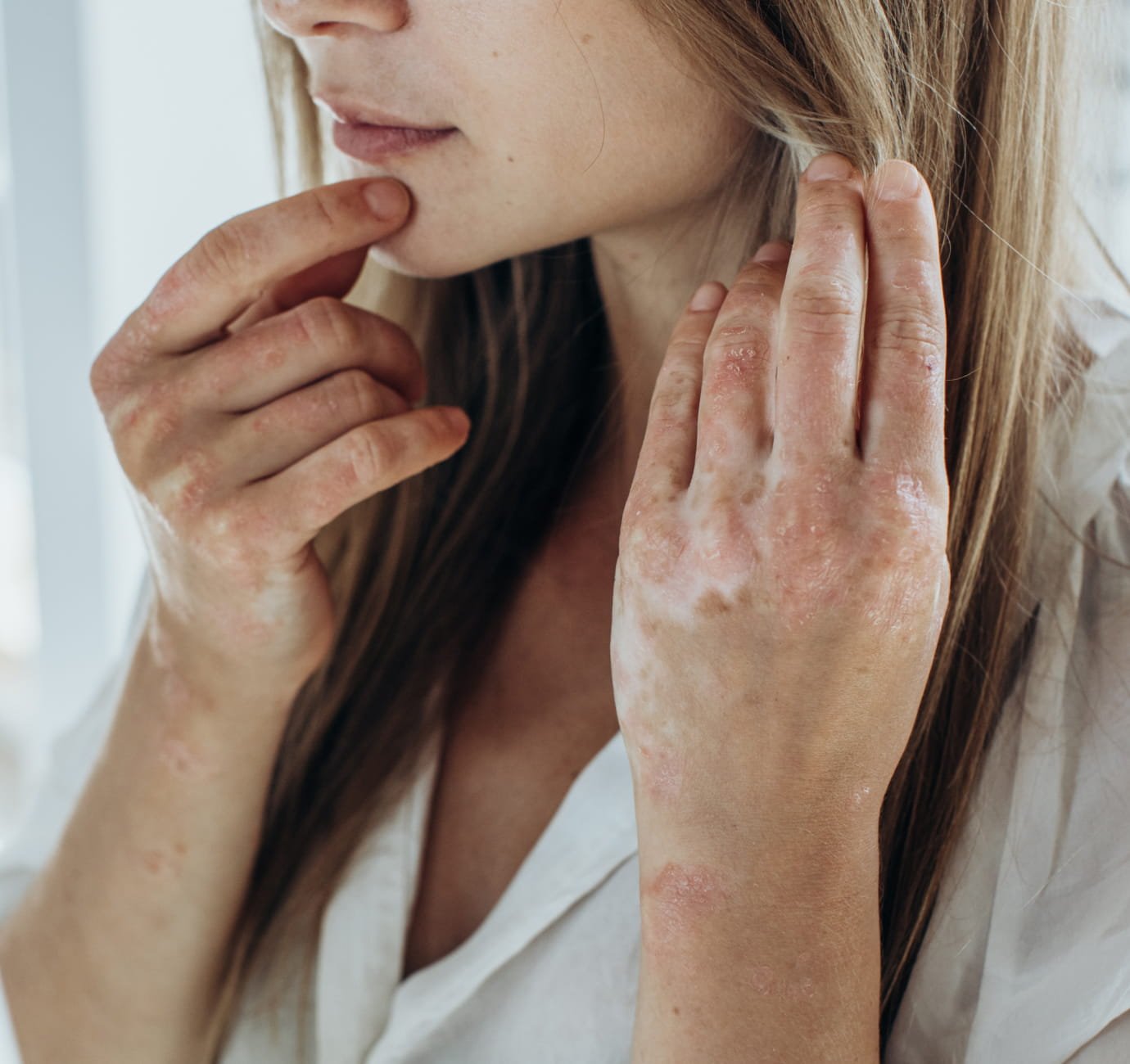
What is psoriasis?
Psoriasis is an immune-mediated skin condition in which skin cells are produced and shed more rapidly than normal, leading to the development of well-defined, scaly plaques. It is not contagious and is not caused by poor hygiene. The condition typically follows a relapsing and remitting course, with periods of improvement interspersed with flares, and its severity can change over time.
Psoriasis affects more than the skin. Up to one-third of patients develop psoriatic arthritis, and the condition is also associated with an increased risk of several metabolic and cardiovascular conditions. Recognising psoriasis as a systemic inflammatory disease is an important part of providing comprehensive long-term care.
Types of psorasis Dr Phillips treats:
Plaque psoriasis The most common form, characterised by well-defined scaly plaques
Plaque psoriasis is the most common form of psoriasis. It is characterised by well-defined, raised plaques covered with silvery-white scale, most commonly affecting the elbows, knees, lower back and scalp, although it can occur anywhere on the body. The plaques may be itchy, painful and prone to cracking, and can have a significant impact on confidence and quality of life.
Treatment is tailored to the severity and extent of the disease. Mild plaque psoriasis is often managed with topical treatments, including vitamin D analogues, topical corticosteroids and combination preparations. More extensive or treatment-resistant psoriasis may require phototherapy, conventional systemic therapies or biologic treatment. Dr Phillips assesses the severity and impact of your psoriasis before developing an individualised treatment plan, reviewing and refining treatment over time as your condition responds.
Living with plaque psoriasis?
Book a consultation to discuss a personalised treatment plan.
Scalp psoriasis Often persistent and easily mistaken for severe dandruff
Scalp psoriasis is one of the most common manifestations of psoriasis and can be particularly challenging to manage. It typically presents with well-defined areas of thick scale, redness and itching, and may extend beyond the hairline onto the forehead, around the ears or the back of the neck. Although it is often mistaken for severe dandruff, the scale is usually thicker, more persistent and accompanied by underlying inflammation.
Treatment of scalp psoriasis involves more than selecting the right medication. The formulation is equally important, as creams and ointments can be difficult to apply through hair. Dr Phillips tailors treatment to the individual, selecting the most appropriate vehicle—such as lotions, foams, gels, solutions or medicated shampoos—according to hair type, the severity of the psoriasis and patient preference.
Many patients rely on over-the-counter dandruff or coal tar shampoos without achieving good control. A review of the diagnosis and current treatment often identifies more effective prescription options, including topical corticosteroids, vitamin D analogues and combination preparations.
Struggling to control scalp psoriasis?
Book a consultation for an accurate assessment and personalised treatment plan.
Facial psoriasis Affecting the hairline, eyebrows, eyelids and central face
Facial psoriasis is less common than psoriasis affecting the scalp or body but can have a disproportionate impact because of its visibility. It most commonly affects the hairline, eyebrows, eyelids, sides of the nose and around the ears. Compared with plaque psoriasis elsewhere on the body, facial psoriasis often presents with thinner plaques, less scale and more prominent redness.
Because of these features, facial psoriasis can resemble other inflammatory skin conditions, particularly seborrhoeic dermatitis. Establishing the correct diagnosis is therefore essential, as the treatment approach differs between these conditions.
Treatment of facial psoriasis requires particular care because facial skin is thinner and more susceptible to the side effects of topical corticosteroids. Dr Phillips develops an individualised treatment plan using the most appropriate therapies for this sensitive area, which may include short courses of topical corticosteroids, topical calcineurin inhibitors such as tacrolimus and measures to restore the skin barrier where appropriate.
Persistent facial redness or scaling?
Book a consultation for an accurate diagnosis and personalised treatment plan.
Nail psoriasis Causing pitting, onycholysis and nail discolouration
Nail psoriasis affects up to half of people with psoriasis and can be particularly challenging to treat. It may present with pitting, ridging, discolouration, onycholysis (separation of the nail from the nail bed) or, in more severe cases, nail thickening and dystrophy. Both the fingernails and toenails can be affected, and the condition is sometimes mistaken for a fungal nail infection.
Nail psoriasis is associated with an increased risk of psoriatic arthritis and often reflects more extensive psoriasis. It can also have a significant functional impact, causing discomfort, difficulty with everyday tasks and reduced confidence.
Treatment depends on the severity of the nail disease and the extent of psoriasis elsewhere on the body. While topical treatments may be appropriate for milder disease, more significant nail involvement often requires phototherapy, systemic treatment or biologic therapy. Dr Phillips assesses nail psoriasis as part of the overall disease rather than as an isolated nail problem, ensuring treatment is matched to the full clinical picture.
Concerned about persistent nail changes?
Book a consultation for an accurate assessment and personalised treatment plan.
Guttate psoriasis Small, raindrop-shaped plaques, often triggered by streptococcal infection
Guttate psoriasis presents as a sudden eruption of numerous small, raindrop-shaped plaques, typically measuring 1–10 mm, scattered across the trunk, arms and legs. It most commonly affects children, teenagers and young adults and is often triggered by a recent streptococcal throat infection, although other infections and stress may also precipitate it.
Unlike chronic plaque psoriasis, guttate psoriasis usually develops abruptly, with hundreds of lesions appearing over the course of days, often in someone with no previous history of psoriasis. Although the rash can appear dramatic, many cases improve spontaneously or respond well to narrowband UVB phototherapy. Some patients subsequently develop chronic plaque psoriasis, while others experience no further episodes.
Dr Phillips carefully assesses the clinical presentation, considers whether a recent streptococcal infection or other trigger may have contributed, and develops an individualised management plan. Depending on the severity and stage of the condition, this may involve observation, topical treatment, phototherapy or further investigation where appropriate.
Developed a sudden, widespread rash?
Book a consultation for an accurate diagnosis and personalised treatment plan.
Flexural (inverse) psoriasis Smooth, inflamed psoriasis affecting skin folds
Flexural psoriasis (also known as inverse psoriasis) affects the skin folds, including the armpits, groin, beneath the breasts, around the navel and between the buttocks. Unlike plaque psoriasis, it typically presents as smooth, well-defined red patches with little or no scale, as the warm, moist environment of the skin folds prevents the characteristic scaling from developing. As a result, it can resemble conditions such as fungal infection, contact dermatitis or intertrigo.
The combination of friction, moisture and occlusion means flexural psoriasis can be particularly uncomfortable, causing soreness, irritation and sometimes painful fissuring. Treatment also requires particular care, as the thinner skin in these areas absorbs topical medication more readily, increasing the risk of side effects if inappropriate treatments are used for prolonged periods.
Dr Phillips carefully distinguishes flexural psoriasis from other conditions affecting the skin folds before developing an individualised treatment plan. Management may include topical corticosteroids, topical calcineurin inhibitors and practical measures to reduce friction and irritation, selected according to the severity and location of the disease.
Persistent redness or irritation in skin folds?
Book a consultation for an accurate diagnosis and personalised treatment plan.
Moderate-to-severe psoriasis ncluding patients who may benefit from systemic or biologic therapy
For patients with moderate-to-severe psoriasis that has not responded adequately to topical treatment or phototherapy, advanced systemic therapies may be appropriate. Biologic medicines are targeted treatments that selectively inhibit the immune pathways driving psoriasis, helping to achieve disease control while avoiding the broad immunosuppression associated with some conventional systemic therapies. Current biologic treatments target cytokines including IL-17, IL-23 and TNF, with the most appropriate choice depending on the pattern and severity of psoriasis, associated medical conditions and individual treatment goals.
Dr Phillips has particular expertise in the use of biologic therapies for psoriasis, developed during his time leading the psoriasis biologics service at Imperial College Healthcare NHS Trust. He has also published research in the British Journal of Dermatology examining the impact of biosimilar switching on treatment continuity in patients receiving biologic therapy for psoriasis. This experience informs his approach to patient selection, treatment monitoring and long-term disease management.
Psoriasis not responding to current treatment?
Book a consultation to discuss whether biologic therapy may be appropriate.
Psoriasis in skin of colour
Psoriasis can present differently in darker skin tones, where the classic features may be less obvious. Rather than appearing bright red with silvery scale, plaques may appear violaceous or dark brown with grey-white scale, and erythema may be less apparent. As plaques resolve, post-inflammatory hyperpigmentation is common and can persist long after the inflammation has settled.
Dr Phillips has extensive experience diagnosing and treating psoriasis across diverse skin tones. Treatment is tailored not only to control active inflammation but also to minimise the risk of post-inflammatory pigmentation and optimise long-term skin health.
If you have psoriasis in darker skin and are looking for an accurate diagnosis and an individualised treatment plan, book a consultation with Dr Derrick Phillips.

Psoriasis and joint pain — Psoriatic Arthritis treatment in London
Up to 30% of people with psoriasis develop psoriatic arthritis, an inflammatory joint condition that can cause pain, stiffness and swelling affecting the fingers, toes, spine and other joints. Joint symptoms may develop before, alongside or after the skin changes of psoriasis, and can sometimes be overlooked, particularly in patients with relatively mild skin disease.
As part of every psoriasis assessment, Dr Phillips screens for symptoms that may suggest psoriatic arthritis. Where there is concern, he will arrange prompt referral to a trusted consultant rheumatologist for further assessment and management, while continuing to optimise treatment of your skin disease. Early recognition is important, as untreated psoriatic arthritis can lead to irreversible joint damage.
If you have psoriasis and are experiencing persistent joint pain, stiffness or swelling, book a consultation with Dr Derrick Phillips for assessment and, where appropriate, referral for specialist rheumatology care.
How psoriasis is treated
Treatment is tailored to the type, severity and distribution of your psoriasis, and may include one or more of the following:
Topical therapies
Vitamin D analogues, topical corticosteroids and combination preparations for mild-to-moderate psoriasis
Phototherapy (narrowband UVB)
For more extensive psoriasis that is not adequately controlled with topical treatment alone
Conventional systemic therapies
Including methotrexate, ciclosporin and acitretin for patients with moderate-to-severe psoriasis
Biologic therapies
Targeted treatments for suitable patients with moderate-to-severe psoriasis
Site-specific treatments
Formulations tailored to the scalp, face, nails and other specialist sites where appropriate
What to expect from your consultation
Your consultation begins with a comprehensive assessment of the type, severity and distribution of your psoriasis, together with a review of previous treatments and any symptoms that may suggest psoriatic arthritis. Dr Phillips will explain the factors contributing to your psoriasis, discuss realistic expectations and develop an individualised treatment plan. Because psoriasis is a long-term condition, follow-up allows treatment to be reviewed and refined over time, with clear guidance on when treatment should be adjusted or escalated.
Comprehensive assessment
Review the type, severity and distribution of your psoriasis, previous treatments and any symptoms of psoriatic arthritis.
Understand your psoriasis
Dr Phillips explains the factors contributing to your psoriasis and discusses realistic treatment expectations.
Personalised treatment plan
Develop an individualised treatment plan based on your symptoms, severity and treatment history.
Ongoing review and follow-up
Follow-up appointments monitor your progress and provide clear guidance on when treatment should be adjusted or escalated.ChatGPT can make mistakes. Check important info.
Why choose Dr Derrick Phillips for psoriasis in London
Dr Phillips spent 12 years working within the NHS, including as a Consultant Dermatologist at Imperial College Healthcare NHS Trust, where he led the psoriasis biologics service for patients with moderate-to-severe disease. He has particular expertise in systemic and biologic therapies and has published research in the British Journal of Dermatology on biologic treatment outcomes in psoriasis. He is also a chapter author of the Handbook of Systemic Drug Treatments in Dermatology (CRC Press). This combination of clinical, academic and research experience underpins his approach to caring for patients with psoriasis across the full spectrum of disease severity.

Dr Phillips's approach to psoriasis is built on:
Accurate assessment of the type, severity and pattern of psoriasis guides treatment selection
Treatment is stepped according to disease severity, from topical therapies through to biologic treatment where appropriate
Particular expertise in systemic and biologic therapies for moderate-to-severe psoriasis
Scalp, nail and facial psoriasis receive site-specific treatment tailored to the area affected
Screening for symptoms of psoriatic arthritis forms part of every comprehensive psoriasis assessment
Extensive experience diagnosing and treating psoriasis across diverse skin tones
FAQs
Can psoriasis be cured?
No. Psoriasis is a long-term immune-mediated condition, but with the right treatment many patients achieve excellent disease control, including complete or near-complete skin clearance. The aim is long-term control and sustained remission rather than a cure.
What triggers psoriasis flares?
Common triggers include stress, infections (particularly streptococcal throat infection), certain medications, alcohol and skin injury. Triggers vary between individuals, and identifying those relevant to you forms an important part of your treatment plan.
What is biologic treatment for psoriasis?
Biologic therapies are targeted injectable treatments that selectively inhibit the immune pathways driving psoriasis. They are used for suitable patients with moderate-to-severe disease and can produce substantial and sustained improvements in skin clearance. Dr Phillips has particular expertise in biologic therapies, developed while leading the psoriasis biologics service at Imperial College Healthcare NHS Trust.
Is scalp psoriasis treated differently from psoriasis elsewhere on the body?
Yes. Successful treatment depends not only on the medication prescribed but also on the formulation. Lotions, foams, gels, solutions and medicated shampoos are often more practical than creams or ointments for scalp psoriasis, improving both application and long-term adherence.
Can psoriasis affect the joints?
Yes. Up to 30% of people with psoriasis develop psoriatic arthritis, which can cause pain, stiffness and swelling in the joints. Dr Phillips routinely screens for symptoms during your consultation and, where appropriate, refers patients to a trusted consultant rheumatologist for specialist assessment and management.
Is psoriasis contagious?
No. Psoriasis is an immune-mediated condition and cannot be passed from one person to another. It is not caused by poor hygiene.
Does psoriasis look different in darker skin tones?
Yes. In darker skin tones, psoriasis may appear violaceous or dark brown rather than bright red, with grey-white scale instead of the classic silvery appearance. Post-inflammatory hyperpigmentation is also common and may persist after the plaques have resolved. Dr Phillips has extensive experience diagnosing and treating psoriasis across diverse skin tones.
Explore knowledge base
Learn more about psoriasis, treatment options and living with a long-term skin condition through Dr Derrick Phillips' expert videos and articles. Explore trusted information to help you better understand your psoriasis and manage it with confidence.
