
Skin conditions do not always look the same across different skin tones. For patients with darker skin tones, this matters for two reasons: some conditions are more common, and many are more likely to be missed or misdiagnosed because clinical training and published medical images have historically focused on lighter skin.
As a Consultant Dermatologist in London with extensive experience treating darker skin tones, Dr Derrick Phillips regularly sees patients with black and brown skin who have spent months, or sometimes years, without the correct diagnosis. Accurate diagnosis is the first step towards effective treatment, particularly when symptoms such as redness, inflammation or pigment change may appear differently in darker skin.
This article covers five skin conditions that are more common in darker skin tones, can present differently in black and brown skin, or are more likely to be missed or misdiagnosed. It also explains what accurate diagnosis involves, and how treatment can be tailored to both the condition and the patient’s skin type.
Why skin of colour needs a different clinical lens
The inflammation, redness and textural changes that make many skin conditions identifiable in lighter skin tones can present differently or be harder to see in darker skin tones. Redness becomes discolouration. Erythema becomes warmth or sensitivity. Subtle early-stage changes that would prompt immediate investigation in a lighter-skinned patient may be attributed to normal variation or missed entirely.
The result is that patients with darker skin tones frequently experience delayed diagnosis, undertreated conditions and a higher burden of post-inflammatory hyperpigmentation from conditions that went uncontrolled. Getting the right diagnosis matters, not just for treatment, but for preventing the secondary skin changes that can be as distressing as the original condition.
1. Dermatosis papulosa nigra
Dermatosis papulosa nigra (DPN) presents as small, dark, raised bumps, typically on the cheeks, temples and around the eyes. They are completely benign, related to seborrhoeic keratoses, and occur more commonly in people with darker skin tones, often running in families. They tend to develop from early adulthood and increase in number with age.
DPN is not a medical concern, but it is a significant cosmetic one for many patients, particularly when bumps appear in visible locations around the eyes and cheeks. The bumps are often mistaken for warts, moles or other lesions, which is why a correct diagnosis is important before any treatment is attempted.
Treatment is straightforward when performed by the right clinician: low-energy electrocautery or curettage removes individual lesions with good cosmetic results and minimal downtime. The key is using appropriate settings and technique for darker skin tones. Incorrectly calibrated energy levels risk post-inflammatory hyperpigmentation or hypopigmentation at treatment sites, which is why DPN should always be treated by a clinician with experience in skin of colour.
Book a consultation with Dr Derrick Phillips in one of his private London dermatology clinics if you have dark raised bumps on the cheeks or around the eyes that you’d like assessed and treated.
2. Lichen planus pigmentosus
Lichen planus pigmentosus (LPP) is an uncommon condition that presents as grey or brown patches on the face, neck and body, and is one of the most frequently misdiagnosed pigmentation conditions in skin of colour. It is often mistaken for melasma (link to new page), and patients regularly arrive having spent months on melasma treatment that hasn’t worked, because the two conditions look similar superficially but have completely different underlying mechanisms and require different treatment approaches.
Melasma is driven by UV exposure and hormonal factors, and responds to sun protection, topical brightening agents and specific chemical peels. Lichen planus pigmentosus is a lichenoid inflammatory condition, related to lichen planus, and while it also results in hyperpigmentation, the pigmentation is the aftermath of inflammation but can also be exacerbated by UV exposure.
Correct diagnosis often requires careful clinical examination and, in some cases, a skin biopsy to confirm the pattern of inflammation. Once diagnosed, management focuses on controlling the inflammatory process, which may include topical steroids, calcineurin inhibitors or, where there is a lichenoid trigger (certain medications or contact allergens), identifying and removing it. The pigmentation itself can take months to fade even when the inflammation is controlled.
Confused by facial pigmentation that isn’t responding to standard treatment? Book a consultation to uncover an accurate diagnosis.
3. Pseudofolliculitis barbae (razor bumps)
Pseudofolliculitis barbae (PFB) — commonly known as razor bumps — occurs when curly hairs re-enter the skin after cutting, triggering an inflammatory foreign-body reaction. The result is red, inflamed, often painful bumps along the beard line, neck and cheeks that can become hyperpigmented and, in severe or longstanding cases, lead to scarring. It is significantly more common in men with Afro-textured hair, where the naturally curved follicle means cut hairs are more likely to curl back and penetrate the skin.
PFB is frequently dismissed as a cosmetic or grooming issue rather than a medical one, but the inflammation is real, the hyperpigmentation it causes can be severe and persistent, and the scarring in chronic cases is permanent. It is not simply a shaving rash.
Treatment addresses both the inflammatory response and the hyperpigmentation it leaves behind:
- Shaving technique — electric clippers rather than close-shave blades reduce the risk of re-entry; single-blade razors with a hydrating shave gel are preferable to multi-blade cartridges for those who shave wet
- Topical retinoids — help prevent ingrown hairs by normalising follicular keratinisation
- Azelaic acid or topical brightening agents — for the post-inflammatory hyperpigmentation
- Laser hair removal — for patients with recurrent, severe PFB, laser hair removal targeting Afro-textured hair with appropriate wavelengths and settings is the most effective long-term solution. This must be performed with equipment and expertise appropriate for darker skin tones
Persistent razor bumps or post-shave hyperpigmentation? Book a consultation with Dr Phillips to assess PFB as both an inflammatory skin condition and a pigmentation concern.
4. Post-inflammatory hyperpigmentation
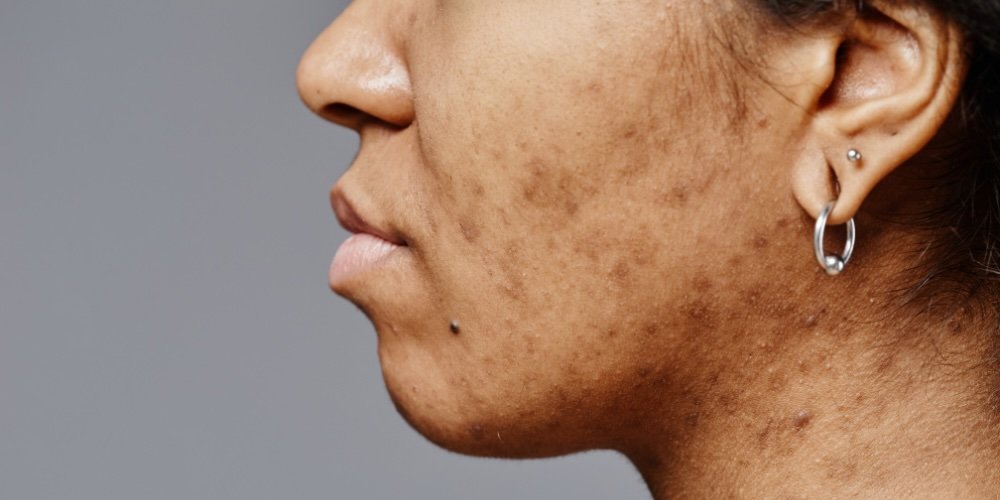
Post-inflammatory hyperpigmentation (PIH) refers to the dark marks on the skin that develop after inflammation — from acne, eczema, a cut, an insect bite, a burn or any other source of skin injury. In darker skin tones, PIH is more pronounced and more persistent. The dark marks can last months or years and are often more distressing to patients than the original condition that caused them.
PIH is not a condition in itself, but it is a consequence of inflammation that wasn’t controlled. Which means the most important thing Dr Phillips does for patients presenting with PIH is identify and treat the underlying cause, not just treat the marks in isolation. Treating PIH while the underlying acne or eczema is still active is like mopping the floor with the tap still running.
Once the underlying condition is controlled, the marks themselves are addressed with:
- Daily broad-spectrum SPF — UV exposure darkens existing PIH significantly, making sunscreen non-negotiable and not seasonal
- Topical brightening agents — azelaic acid, niacinamide, vitamin C, kojic acid and prescription-strength hydroquinone where appropriate
- Topical retinoids — accelerate cell turnover and help fade pigmentation over time
- Chemical peels — carefully selected acids at appropriate concentrations for skin of colour
- Laser treatment — where PIH is stubborn and the skin tone is appropriate for treatment; laser choice for pigmentation in skin of colour requires specific expertise to avoid worsening the problem. Dr Phillips uses the Nd:YAG Laser and PicoWay for darker skin tones.(link to new pages)
Acne marks or dark spots that won’t fade? Book a consultation to address PIH as part of a comprehensive plan that controls the cause and corrects the marks.
5. Central centrifugal cicatricial alopecia (CCCA)
Central centrifugal cicatricial alopecia (CCCA) (link to hair loss page) is a scarring hair loss condition that primarily affects women of African ancestry. It starts at the crown of the scalp and spreads outward in a centrifugal pattern, destroying hair follicles and replacing them with scar tissue. The loss is permanent in areas where scarring has occurred, which is what makes early diagnosis so critical.
CCCA is frequently missed in its early stages. Patients may notice gradual thinning at the crown and attribute it to normal hair loss, styling damage or product build-up. The scalp may be tender, itchy or sensitive, but these symptoms are often not connected to a hair condition. By the time the hair loss becomes visually obvious, significant follicular destruction may already have occurred.
The cause is not fully understood but is thought to involve a combination of genetic predisposition, follicular inflammation and, in some cases, certain hair care practices — including tight braiding, chemical relaxers and heat styling — that may exacerbate an underlying follicular vulnerability. Addressing hair care practices is part of management but is not a substitute for medical treatment.
Early treatment aims to halt progression — the inflammation driving the scarring can be suppressed with topical steroids, intralesional steroid injections and, in more active or extensive cases, systemic anti-inflammatory or immunomodulatory treatment. Once the active phase is controlled, minoxidil may support regrowth in areas not yet fully scarred. Hair transplant is a consideration for stable, longstanding CCCA where the inflammatory process has been dormant.
Crown thinning or scalp sensitivity that isn’t improving? Book a consultation urgently, as CCCA requires prompt treatment to prevent permanent loss. Early intervention makes a significant difference to what can be preserved.
The common thread with dark skin tones: diagnosis first
What links all five of these conditions is that they are frequently misdiagnosed, or missed entirely, because they present differently in darker skin tones than the presentations most clinicians have been trained to recognise. DPN looks like warts. LPP looks like melasma. PFB is dismissed as a shaving problem. PIH is treated without anyone addressing the underlying cause. CCCA is attributed to styling until permanent scarring has already occurred.
Dr Phillips has specific expertise in diagnosing and treating skin conditions across all skin tones, with particular attention to the conditions that disproportionately affect patients with darker skin and the clinical adjustment.

Why choose Dr Derrick Phillips for skin of colour
Dr Phillips has extensive clinical experience in skin-of-colour dermatology, with a particular focus on accurate diagnosis before treatment begins. His expertise includes conditions that are more common, present differently or behave more aggressively in darker skin tones, including pigmentation, keloid scarring, scarring hair loss and inflammatory skin conditions where standard treatment approaches may need to be adapted.
His approach considers both the medical and cosmetic impact of these conditions, so treatment is tailored not only to the diagnosis, but also to the way the condition affects each patient’s skin, confidence and quality of life.
FAQs
What is dermatosis papulosa nigra?
Dermatosis papulosa nigra (DPN) is a benign condition causing small, dark, raised bumps on the cheeks, temples and around the eyes, more common in darker skin tones. It is harmless but can be treated cosmetically with low-energy electrocautery or curettage by a clinician experienced in treating skin of colour.
What is the difference between lichen planus pigmentosus and melasma?
Both cause grey or brown facial pigmentation in darker skin tones, but they have different underlying mechanisms and require different treatments. Melasma is UV and hormonally driven; lichen planus pigmentosus is a lichenoid inflammatory condition. Treating one as the other rarely works — accurate diagnosis is essential before starting treatment.
What causes razor bumps and how are they treated?
Razor bumps (pseudofolliculitis barbae) occur when curly hairs re-enter the skin after cutting, causing inflammation and hyperpigmentation. Treatment includes adjusting shaving technique, topical retinoids and anti-inflammatory agents for the inflammation, brightening agents for the pigmentation, and laser hair removal for severe or recurrent cases.
How long does post-inflammatory hyperpigmentation last?
PIH in darker skin tones can persist for months to years without treatment. Daily SPF, topical brightening agents and treating the underlying cause — acne, eczema or other inflammation — are the cornerstones of management. Chemical peels and laser treatment can accelerate fading in appropriate cases.
What is CCCA and why is early diagnosis important?
Central centrifugal cicatricial alopecia (CCCA) is a scarring hair loss condition affecting women of African ancestry, starting at the crown and spreading outward. Because scarring destroys follicles permanently, early diagnosis and treatment to halt the inflammatory process are critical — hair lost to established scarring cannot be regrown.
Does skin of colour need different dermatology treatment?
Yes — many skin conditions present differently in darker skin tones, some are more prevalent, and treatments such as laser therapy require different parameters to be safe and effective. Working with a dermatologist experienced in skin of colour makes a significant difference to both diagnosis accuracy and treatment outcomes.