
Alopecia barbae is a form of alopecia areata that causes patchy, non-scarring hair loss in the beard. It occurs when the immune system targets hair follicles, disrupting normal hair growth. Although medically benign, the condition can have a meaningful psychological impact due to its visible nature.
For many men, a beard is more than just hair—it’s part of how they see themselves. So when patches of hair begin to fall out, it can feel unsettling, frustrating, and difficult to ignore.
In this article, consultant dermatologist Dr Derrick Phillips explains the causes of alopecia barbae, how it presents, and the evidence-based treatment options available to support regrowth of beard bald spots and restore confidence.
What Is Alopecia Barbae?
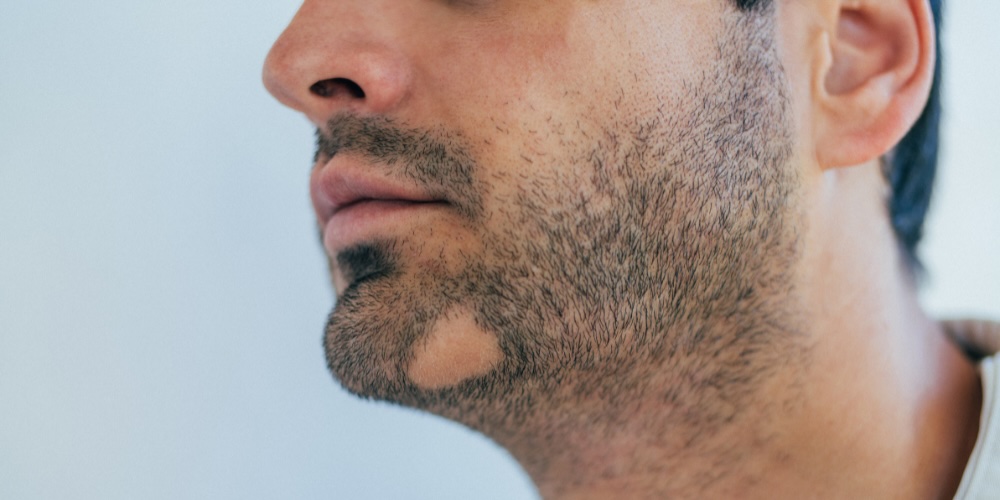
Alopecia barbae is an autoimmune condition in which the immune system targets hair follicles within the beard region. This results in well-defined, circular areas of hair loss, most commonly affecting the jawline, cheeks, and neck.
Unlike scarring alopecias, the stem cells remain intact, meaning regrowth is possible. However, the course of the condition is often unpredictable, with episodes of spontaneous regrowth and recurrence.
Alopecia barbae sits within the broader spectrum of alopecia areata, and patients may have or go on to develop hair loss in other areas of the body.
What are the cause of bald patches in the beard?
The pathogenesis of alopecia barbae is driven by an autoimmune-mediated disruption of the hair growth cycle. Immune cells, particularly T-lymphocytes, target the hair follicle, prematurely shifting it from the growth (anagen) phase into a shedding phase.
While the precise trigger remains unclear, there is a recognized association with:
- Genetic predisposition to autoimmune disease
- Atopic conditions such as eczema or asthma
- Periods of physiological or psychological stress
It is important to note that stress is not a direct cause but may act as a precipitating or exacerbating factor in susceptible individuals.
What Does Alopecia Barbae Look Like?
Alopecia barbae typically appears as one or more smooth, round or oval bald patches within the beard. The skin in these areas looks completely normal, usually there is no redness, scaling, or scarring, which is what distinguishes it from a fungal infection or an inflammatory skin condition.
In some cases, short, stubby hairs may be visible at the edges of a patch. These tapered hairs, sometimes called exclamation mark hairs, are a sign of active hair loss and can help a dermatologist confirm the diagnosis. Some patients also notice a mild tingling or itching sensation in the affected area before the hair begins to fall out, though many experience no symptoms at all.
The patches can appear suddenly and may enlarge, multiply, or occasionally resolve on their own without treatment.
Alopecia Barbae vs Other Causes of Patchy Beard Hair Loss
Not all patchy beard hair loss is alopecia barbae. Several other conditions can cause bald spots or thinning in the beard area, and the treatment for each is different, which makes getting the right diagnosis important before starting any treatment.
Alopecia Barbae vs Tinea Barbae (Fungal Infection)
Tinea barbae is a fungal infection of the beard area caused by dermatophytes. Unlike alopecia barbae, it typically presents with redness, scaling, crusting, and sometimes pustules around the affected follicles. The skin within the patch is visibly inflamed rather than smooth and normal-looking. Tinea barbae can also cause broken hairs rather than complete hair loss. It is treated with antifungal medication, not corticosteroids, which is why distinguishing it from alopecia barbae matters. A skin swab or scraping can confirm a fungal cause.
Alopecia Barbae vs Folliculitis
Folliculitis is an infection or inflammation of the hair follicles, often triggered by shaving, ingrown hairs, or bacterial infection. It typically presents as small red bumps or pustules clustered around individual follicles, which is quite different from the smooth, round bald patches of alopecia barbae. Mild folliculitis often resolves on its own or with antibacterial washes, but persistent or deep folliculitis should be assessed by a dermatologist to rule out other causes.
Alopecia Barbae vs Traction or Shaving Damage
Repeated shaving irritation, pressure, or traction can cause localised hair thinning over time. Unlike alopecia barbae, shaving-related hair loss tends to be gradual rather than sudden, and the skin around the affected area will usually show signs of irritation, redness, or ingrown hairs. Changing shaving technique and using a gentle post-shave routine typically leads to improvement — something that would not happen with alopecia barbae.
Alopecia Barbae vs Male Pattern Hair Loss Affecting the Beard
Androgenetic alopecia (male pattern hair loss) primarily affects the scalp, but in some men it can also contribute to a gradual reduction in beard density over time. This differs from alopecia barbae in that it is slow and diffuse rather than sudden and patchy. There are no well-defined bald spots, and the hair simply becomes finer and less dense across a broader area. A dermatologist can distinguish between the two with a clinical examination and, where needed, dermoscopy.
When the Cause Is Unclear
If you are unsure what is causing patchy beard hair loss, the most important step is to get a clinical assessment before trying to treat it yourself. Applying the wrong treatment — such as an antifungal for alopecia barbae, or a corticosteroid for a fungal infection — will not work and can delay appropriate care.
How Does Beard Hair Loss Affect Mental Health?
Although alopecia barbae does not pose a physical health risk, its impact on mental wellbeing should not be underestimated.
Facial hair is often closely tied to identity, masculinity, and self-image. As a result, even small areas of hair loss can lead to disproportionate psychological distress.
Patients may experience reduced confidence, heightened self-awareness in social settings, and anxiety related to the unpredictability of the condition. For some, this can influence professional interactions and overall quality of life.
Alopecia Barbae Treatment: What Actually Works
There is no single cure for alopecia barbae, but several treatments have good evidence behind them and can significantly improve regrowth — particularly when started early. The right option depends on how many patches are present, how active the hair loss is, and how the skin has responded to previous treatment.
Corticosteroid Injections
Intralesional corticosteroid injections are the most effective first-line treatment for localised alopecia barbae. A small amount of corticosteroid is injected directly into the affected area, suppressing the immune response that is targeting the hair follicle. Most patients see regrowth within six to eight weeks. The treatment is well tolerated and can be repeated if new patches develop.
Topical Corticosteroids
For milder or early-stage cases, a high-potency topical corticosteroid applied directly to the bald patch is a practical starting point. It is less targeted than an injection but appropriate for patients who prefer to begin with a non-invasive option. Results tend to develop more slowly than with injections.
Topical Minoxidil
Minoxidil is commonly associated with scalp hair loss, but it can also be used in the beard area to help stimulate follicle activity and support regrowth alongside other treatments. It is not typically used as a standalone therapy for alopecia barbae, but as an adjunct it can be a useful addition to a treatment plan.
Contact Immunotherapy
For patches that have not responded to corticosteroids, topical immunotherapy — most commonly diphencyprone (DPCP) — can be used to deliberately provoke a mild immune response that redirects the body’s attack away from the hair follicle. This treatment is administered in a dermatology setting and requires ongoing monitoring.
Oral Immunosuppressants
For patients with extensive or rapidly progressing beard hair loss that has not responded to topical or injected treatments, oral immunosuppressants may be considered. These include oral corticosteroids, ciclosporin or newer medications known as JAK inhibitors (e.g. Ritlecitinib) and are prescribed under specialist supervision, with careful attention to side effects and duration of use.